
What is my Identity as a Creative?
So creating a mind map of my Idrntity as a creative highlights the primary areas I work in – Art, Design and Crafts. But this is also with a large part in Media in terms of photography and digital promotion and documentation, for aesthetics and as a business tool. But also with elements of all the other areas within the Creative and Cultural Industries. These are also influenced by and backed up with societal factors that may push or pull my work in different directions and limit or enhance my success, such as a need to embrace technology to launch my work into the digital field.
This has been a great exercise in demonstrating the inter connectivity of disciplines and also highlights areas that are possible collaborative projects – particularly, photography, media, marketing, gallery curation and live events, perhaps an immersive visual display?
Task 4 part two
Using the examples from ‘Cultural Ecology and Cultural Critique, reflect on the different contexts/user groups and identities of the arts/cultural/design practitioner in the creative and cultural industries.
My perception of the three examples is that these examples of Cultural Ecology and Cultural Critique, is the difference in how these events came to be. The MACAO project was a cultural Intervention, a creative event that had anarchic roots of illegal occupation as a statement of ant-capitalism and born out of a need to create Culture rather than commerce. Yet this bottom up approach by this artist collective would serve to generate economy through its high value of production and social significance.
The second example of ‘Forest Law’ is a more academic research funded project that served to impart knowledge and highlight environmental concerns through the ethos of eco-aesthetic and resulted in a book that accumulated interdisciplinary creative projects of Anazonia. Necessarily highlighting the co-existence and co dependency of human and non- human within the forest as its own cultural eco-system. It appears to me that this example shows a top-down cultural critique, just as valid but possibly less far -reaching with a smaller User group. Both of these projects were a conscious cultural development within the creative industries.
The third example ‘Everybody in the place, an incomplete history of Britain, 1988 – 1994 is an example of un unconscious cultural phenomenon within the Creative industries. Born of societal shifts and happenings such as the Miners strike and mass unem, there developed a revolutionary shift in cultural experience. As an escape from the tedium of menial work, unemployment and the fracturing influence on community from the Thatcher era, the technological advances in music production led to the birth of electronic music and the rave scene. Sweeping through the country, the initial emergence wasn’t a desire to make culture , it was through entertainment, parties, dancing and escapism through drug abuse – the use of ecstasy. This critique showed that this was a huge change within society that shaped the creatice and cultural industries in a massive way and had major influence that is still felt today in our social world.
So the ‘Temporay contemporary, example appears to be a reflection of these three examples. A ‘placemaking project with no end goal but valuing the importance of creativity within society. A creative cuktural ecology for people to create and experience culture alongside promoting urban regeneration through experience. This is an interesting concept that appears to me an open ended project where the cultural value is simply its existence. This should be an example that should be a constant directive within cities all over the country with no end in sight once a city is ,regenerated, It would have greater value if this was a constant shifting development making use of all unoccupied venues through a city or town.
M.A.C.A.O and the Gadla Tower in Milan, Italy
This artist led movement was a reclamation of a disused building in the centre of Milan, the Gafla Tower in, to go against mass consumerism and invest in ‘placemaking’ – a revolutionary and anarchic occupation to try and promote art and culture within Urban regeneration. The artists occupied the space illegally, squatters reclaiming a space in the city, creating culture out of dissonance. Although the tower was only Ocuupied for a few days before it was evicted, it was possibly a good way to highlight the cause, may have caused a media stir with it’s illegality. They then went on to occupy another disused building, an Art Nouveau slaughterhouse. Even though an illegal occupation , the inhabitants regenerated and refurbished the place to be used as a creative space.
The initiative to create a space for cultural projects wasn’t just a place to make but also a skills sharing exercise too. This would be a great way to get a project off the ground. Quite often as Creative individual, one of the inhibitors of developing your work further is the lack of resources, technical ability in other disciplines and the need for a skilled taskforce to achieve the end goal. For example in my own practice, some of the limits of self promotion to the desired level of High end Fashion with an artistic prevalence rather than commercial production, the key to promotiuon is having photographic content of exceptional quality that can equate to other competitors, they beauty of the internet is that if your images are of the same quality as say Dior then that can elevate the esteem of your work. So to have a space and technically skilled practitioners this would be possible. This could benefit many small scale practitioners with their projects. One of my rasons for studying for the MA is to be in the creative environment where we all bounce ideas off each other, have access to other dsciplines and practical workshops with technology and equipment that is unavailable elsewhere. Also having the scope to collaborate with others that are expersts in this field, which would save so much time and energy to achieve the desired goal. If there was a creative environment to be able to achieve this outside of the University, this would be a massive aid to cultural and creative development. Also to take over unsudes building ‘fills in the urban cultural voids’ that hinder the wellbeing of a community. Even if you aren’t directly involved in the creative process to see buildings and spaces regenerated with these projects creates a sense of wellbeing and future cultural development. This activist movement is needed across many cities in the country after the social phenomenon of the pandemic. In particular the city centre of Sheffield, where I live is in decay. The main street and shopping are have lost approximately 70 percent of its retail stores. Having the shopping Centre Meadowhall means that all the commercial retail spaces are there rather than in the city centre. This stae in the pandemic recovery is prime opportunity to regenerate this city centre. Occupying the now empty department stores of Debenhams and John Lewis, these kind of @creative crucibles’ would re engage communities, help lift creative projects off the ground and change the dynamic of the city centre to independent creative culture, an opportunity to re inhabit the retail stores with independent reatailers, rather than the chain stores that inhabit Meadow hall. City councils need to seize this opportunity and invest in these spaces, allow such occupations to occur and give the city the foundations to regenerate and therefore boost the social, cultural and economic recovery of cities.
T J demos
This exercise to create a mind map of the Cultural and Creative Industries has illustrated just how many disciplines overlap and are connected to, and influenced by societal factors. as John Holden states ‘this is a messy eco-system’! It was very difficult to categorise creative sectors into specific areas, requiring lengthy reflection as to how to format this mind map.
I decided to use what I believe to be the key areas with examples disciplines within these areas.
Then other aspects needed consideration, how the creative industries are affected by the society we live in and its functionality, such as Government Policy, Technological advances or Education – all of which have cultural currency and highlight the organic nature of the Creative and Cultural Industries.
For a very current example; the unexpected event of the Corona Virus Pandemic, how this has affected our lives in relation to the economy, our working methods, our sense of peace, relationships and perpetuated a shift our life priorities and perspectives. This has influenced our creativity on a personal level and in a commercial and within the Arts. Elevating the necessity to be aware of wellbeing and since restrictions have lifted there has been another shift in perspective. In terms of my own work I have seen a great increase in people wishing to be creative and crafty, combined with the need for social contact for those now working from home.
From this reflection, I also realised that the common denomator transversing the Creative sectors and Societal factors – every aspect of this mind map is Wellbeing.
Our sense of peace is affected by our environment; how we inhabit public spaces, our domestic spaces and the workplace. Our happiness influences the choice of clothes we wear, how we interact with each other on social media, our sociability. Technological advances that help us with showing and documenting our work and sociability, education.
This has made me think about how my work can affect wellbeing, my own personal wellbeing in terms of being creative but also how my work can affect the wellbeing of the individual that wears it, the joy of wearing an artwork, the confidence and feeling of wearing a beautifully fitted garment, the admiration of others and a sense of unique individuality.
So where do I fit in to these Creative and Cultural Industries?
The need to have a blog for reflective content has pushed my motivation to start the process of having new websites built; one for my couture label Sivinska and one for my classes and freelance work – Cathie’s Creative – where you are now!. I have decided to use this as a business aid to let the users of my site learn about my progress and development. This will also be a space to upload content to Instagram and facebook. And another digital platform to learn!
The second task of starting a research folder I had already done, as I know how easy it is to get lost with content and being organized make life so much easier and achieves greater focus.
It was specified that our research needs to be documented on a digital platform. This is fine for the written side of the research but l feel sometimes this lacks the warmth and tactile nature of sketchbooks and sample folders. Although this would be a good opportunity to explore using drawing tablets and experimenting with the effects for re- creating a ‘drawn’ or ‘painted’ style. so maybe both formats will be good and perhaps some video content on the digital platforms to show the 3D aspect of practical element.
So our first task is to create three slides to show our current practice and areas we wish to explore on the course.
My current practice mainly revolves around bespoke bridal commissions but my main focus are some other pieces that have developed my creativity and ability in pattern cutting. Highlighting an interest in the human form, anatomically and artistically. Also drawing from my love of corsetry, the historical and contemporary, this in combination with exploratory and experimental pattern cutting with a strong sculptural element.
This process has highlighted a vital need to get up to speed with digital platforms and to clearly organise my thoughts ideas and practice!
This was actually my first time using Power point can you believe? Life as a busy single Mum running my own business for ten years hasn’t previously been a requirement. Narrowing down the image selection to just fit onto three slides, was quite difficult.. There are so many aspects of pattern cutting, artistry, and the aspect of giving my work a cohesive content, will I have thetime or opportunity to embrace them all?
Getting to grips with the digital platforms is essential to progress my development, and will hopefully become a natural way of working – the key is to keep on to p of documenting and uploading all research content and also ideas and reflections.
At the moment it feels like a mountain to climb and I am aware that I may need some training in the digital processes to reach the same ability as other students. On the flip side of this I’m fairly sure my practical experience in Fashion and Textiles will be drawn upon to help others on the course with their practice, maybe we can collaborate?
A great first day on Campus, a great site with inspirational Architecture and a great creative feel to the site.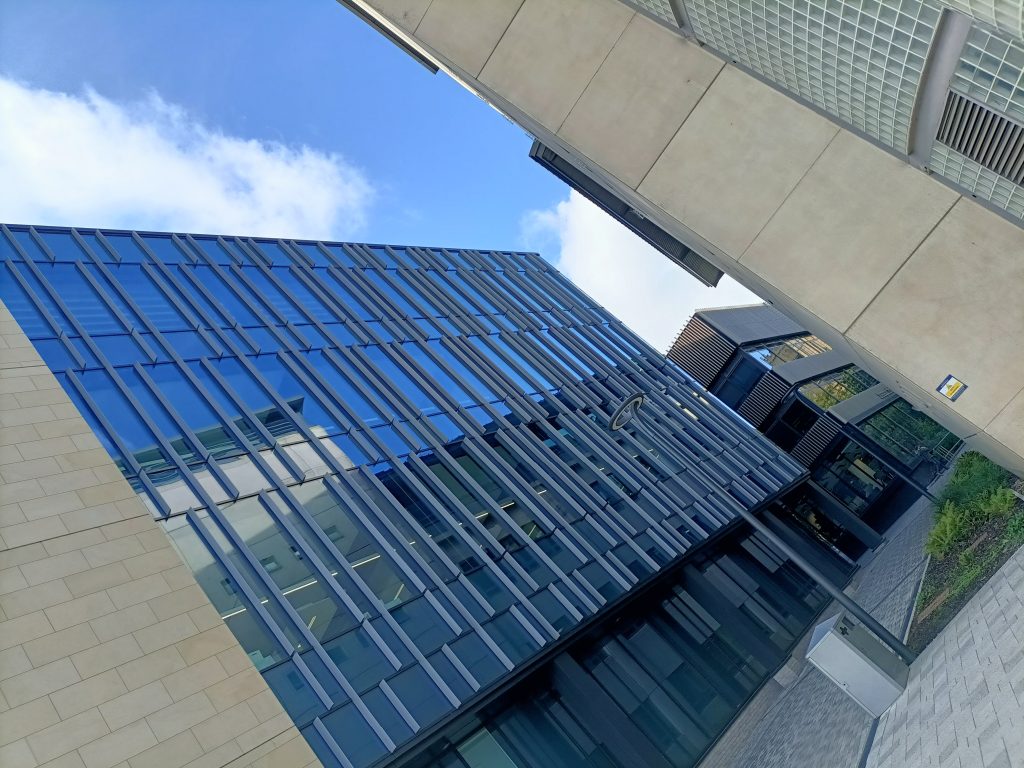
Module 1: Research Methods and Project Proposal
After a long break from academia, this return to a scholarly environment gives me slight apprehension but also great excitement.
Our introductory talk with Rowan Bailey and Anneka … showed me that is going to be a great platform to indulge my interests and creativity. The lecturers have a very supportive attitude and were very approachable with clear academic integrity.
 I will be writing this blog as an insight to my time studying for a Masters degree in Fashion: Creative Pattern Cutting at the University of Huddersfieldand will bepublished on my business website Cathie’s Creative. As a tutor myself it is important to inspire and lead the people you teach to explore their own creativity, I’m sure my clients will be keen to see my progress.